Conditional Category for Dokan: Precision Control and Intelligent Governance for Multivendor E-Commerce
Conditional Category for Dokan is the authorization-powered plugin that brings enterprise-level product governance to your Dokan multivendor marketplace. In an era where marketplace competition intensifies daily and customer expectations reach unprecedented heights, the ability to enforce clean, consistent, category-appropriate product data is not merely a convenience—it is a strategic imperative. This comprehensive solution transforms how vendors interact with your platform, how customers discover products, and how search engines evaluate your catalog’s quality and relevance.
The Architecture of Intelligent Product Forms
To appreciate why Conditional Category for Dokan delivers transformative value, we must examine the architectural philosophy that distinguishes it from superficial alternatives. Many marketplace operators attempt to solve attribute clutter through manual workarounds: custom CSS that hides fields, JavaScript snippets that disable inputs, or vendor training documents that explain which fields to ignore. These approaches share a fatal flaw—they treat symptoms rather than causes, and they break catastrophically whenever underlying platforms update.
Native Integration at the Data Layer
Unlike generic form plugins that manipulate the Document Object Model with fragile JavaScript overlays, Conditional Category for Dokan operates at the data layer where WooCommerce global attributes meet the Dokan vendor dashboard. It integrates with WooCommerce attribute taxonomies natively, respecting the database schema, API endpoints, and data validation rules that govern product information. This architectural integrity ensures that when WooCommerce releases a security patch, when Dokan introduces a new dashboard feature, or when WordPress updates its core functionality, your conditional attribute logic remains stable and functional.
The plugin intercepts attribute rendering at the appropriate hook points within Dokan’s frontend dashboard templates. Before any HTML generates for the product form, the plugin evaluates the selected product category against your configured mappings. Only attributes explicitly permitted for that category proceed to rendering. Irrelevant attributes never reach the browser, eliminating both visual clutter and the temptation for vendors to populate them with placeholder data.
Real-Time Dynamic Adaptation Without Performance Penalty
The conditional logic executes through optimized JavaScript that responds instantly to category selection changes. When a vendor switches from “Uncategorized” to “Women’s Running Shoes,” the attribute panel updates within milliseconds to display “Size,” “Color,” “Material,” “Sole Type,” “Water Resistance,” and “Arch Support” while hiding “Screen Size,” “Battery Life,” and “Processor Speed.” This responsiveness creates a fluid, app-like experience that vendors associate with professional-grade platforms.
Critically, this performance does not come at the cost of server resources. Attribute-category mappings are cached using WordPress’s transients API, meaning the database queries required to determine which attributes belong to which category execute only when mappings change—not on every page load. For high-traffic marketplaces processing hundreds of concurrent vendor sessions, this efficiency prevents the dashboard slowdowns that plague less optimized solutions.
What Makes Conditional Category for Dokan Different?
The marketplace plugin ecosystem contains numerous tools promising to improve vendor experience. Conditional Category for Dokan distinguishes itself through several non-negotiable qualities that serious marketplace operators demand:
Reliability Through Design Philosophy
The plugin is built on a simple principle: extend rather than replace. It does not create parallel attribute systems that compete with WooCommerce’s native functionality. It does not require template overrides that introduce maintenance debt. It does not depend on external SaaS services that introduce latency, subscription costs, and vendor lock-in. Every feature is designed to complement and enhance your existing WordPress, WooCommerce, and Dokan investments.
Security Through WordPress Standards
Security cannot be an afterthought for marketplace platforms handling vendor financial data, customer personal information, and transactional records. Conditional Category for Dokan implements WordPress security best practices throughout its codebase. All administrative actions verify user capabilities through
current_user_can() checks. Form submissions include and validate WordPress nonces to prevent cross-site request forgery. All database interactions use prepared statements and WordPress’s $wpdb abstraction layer. User inputs undergo rigorous sanitization before storage or display. These practices align with WordPress’s own security model, ensuring that the plugin strengthens rather than compromises your platform’s security posture.Scalability Through Efficient Implementation
Marketplace growth should excite, not terrify. Whether your platform serves fifty vendors or five thousand, Conditional Category for Dokan maintains consistent performance. The plugin’s database footprint is minimal—only category-attribute relationships are stored, and these are indexed for rapid retrieval. Memory usage during dashboard rendering increases negligibly compared to the default Dokan experience. For marketplaces anticipating rapid scaling, this efficiency eliminates infrastructure concerns that might otherwise constrain growth.
Ideal Use Cases: Precision for Every Vertical
The versatility of Conditional Category for Dokan enables transformative improvements across virtually every marketplace vertical. Consider how conditional attribute logic addresses the unique challenges of diverse product categories:
Electronics and Technology Marketplaces
Technology products demand some of the most granular attribute specifications in e-commerce. A modern smartphone requires fields for display technology, resolution, pixel density, refresh rate, processor model and generation, RAM configuration, storage options, expandable storage support, rear camera count and megapixels, front camera specifications, battery capacity, charging wattage, wireless charging support, biometric authentication methods, water resistance rating, network generation compatibility, SIM configuration, operating system version, and dimensions with weight.
When these twenty-plus fields appear only for electronics categories, vendors selling unrelated products are spared from this complexity. Meanwhile, technology vendors receive the comprehensive specification tools they need to compete with dedicated retailers like Best Buy or Newegg. The result is a marketplace where electronics listings contain the rich detail that informed buyers expect, without imposing that burden on sellers in other departments.
Fashion and Apparel Platforms
Clothing marketplaces navigate a labyrinth of sizing systems, fit variations, and material specifications. A single apparel item might require attributes for size (US, UK, EU, numeric, or alpha systems), color with hex code support, material composition percentages, care instructions, fit type (slim, regular, relaxed, oversized), sleeve length, neckline style, closure type, pattern, seasonality, and transparency rating. These fields are essential for fashion vendors but completely meaningless for sellers of digital products, home appliances, or professional services.
Conditional logic ensures that fashion vendors see comprehensive sizing and material options while other sellers encounter their own relevant fields. This specialization demonstrates marketplace expertise that attracts serious fashion brands and reduces the return rates caused by sizing confusion or material mismatches.
Home, Garden, and Furniture Marketplaces
Dimensional accuracy is paramount for furniture and large home goods where shipping costs, assembly requirements, and space planning depend on precise measurements. These marketplaces require attributes for assembled dimensions, packaged dimensions, weight, material, finish, assembly required indicator, warranty duration, care instructions, and room type recommendations. At the same time, they might host vendors selling small decor items, gardening tools, or outdoor equipment with entirely different specification needs.
Conditional Category for Dokan enables each product type to receive its appropriate measurement and specification fields without cross-contamination. Furniture buyers see the dimensional data they need for space planning. Garden tool buyers see power specifications and cutting widths. Each vertical maintains its identity within the unified marketplace catalog.
Digital Products and Services
The rise of digital marketplaces—for software, creative assets, online courses, consulting services, and subscription products—introduces attribute requirements that diverge completely from physical goods. File format, file size, license type, usage rights, compatibility requirements, subscription billing interval, support tier, update policy, and refund eligibility become the critical specification fields. These digital-specific attributes would confuse physical product vendors and clutter forms for tangible goods sellers.
Conditional logic creates clean separation between digital and physical product workflows. A graphic designer selling logo templates sees fields for file formats and licensing terms. A furniture maker sees dimensions and material options. Neither encounters irrelevant fields that degrade their experience or introduce completion errors.
Hybrid and General-Purpose Marketplaces
Perhaps the most compelling use case involves marketplaces that deliberately span multiple verticals. Amazon-style everything-stores, regional platforms serving diverse local businesses, and B2B procurement hubs must accommodate vendors selling chemicals, clothing, software, and consulting simultaneously. Without conditional logic, these platforms face an impossible choice: overwhelm every vendor with all possible fields, or limit attributes to a lowest-common-denominator subset that satisfies no one.
Conditional Category for Dokan resolves this dilemma by making the product form contextually aware. Each vendor sees precisely the fields their category demands, regardless of what other sellers on the platform require. The marketplace scales vertically and horizontally without sacrificing data quality or vendor experience.
Easy Activation and Professional Management
Implementing Conditional Category for Dokan follows a streamlined process designed for administrators of all technical backgrounds:
Purchase and License Selection
Visit dokanconditionalattribute.com to review our transparent pricing structure. We offer tiers calibrated to marketplace maturity:
-
Single Site: Ideal for boutique marketplaces, proof-of-concept platforms, and individual entrepreneurs launching their first multivendor store.
-
Multi-Site: Perfect for growing businesses with regional variations, brand portfolios, or staging-production environments requiring multiple installations.
-
Business Unlimited: Engineered for agencies managing client marketplaces, franchise networks with numerous locations, and enterprise deployments requiring unlimited site activations under centralized billing.
Each tier includes the complete feature set—there are no artificial limitations or premium upsells required to access core functionality.
Authorization and Domain Registration
After purchase, you receive an authorization token through our secure delivery system. Install the plugin through your WordPress admin, then navigate to the Authorization Manager dashboard. Enter your token, and the system validates against our licensing server, registers your domain, and activates your feature set. This process typically completes in under thirty seconds and requires no technical configuration.
The Authorization Manager also handles ongoing license synchronization. If you upgrade your tier, transfer ownership, or modify your installation, the dashboard provides self-service tools to manage these changes without contacting support.
Category-Attribute Mapping
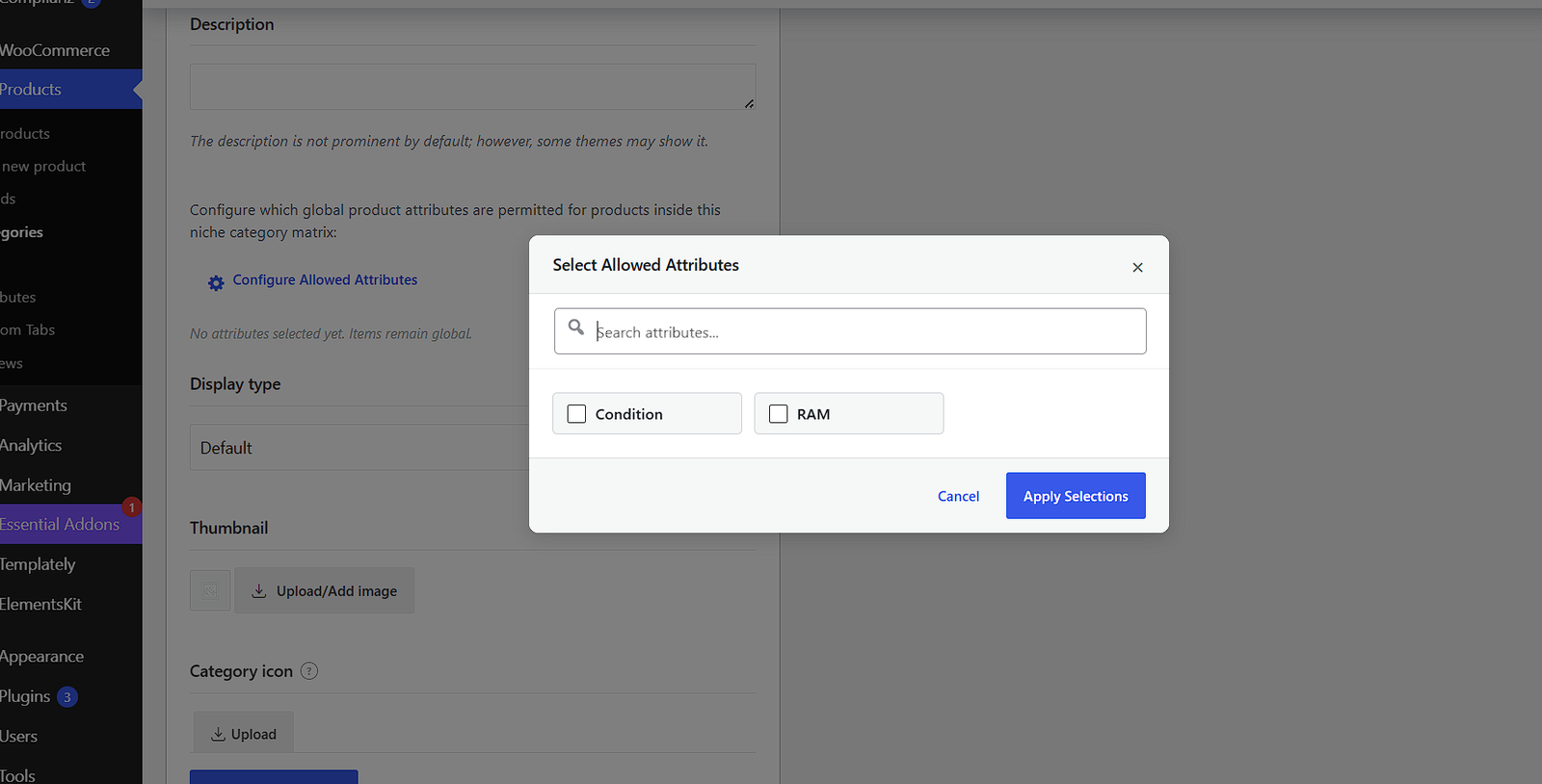
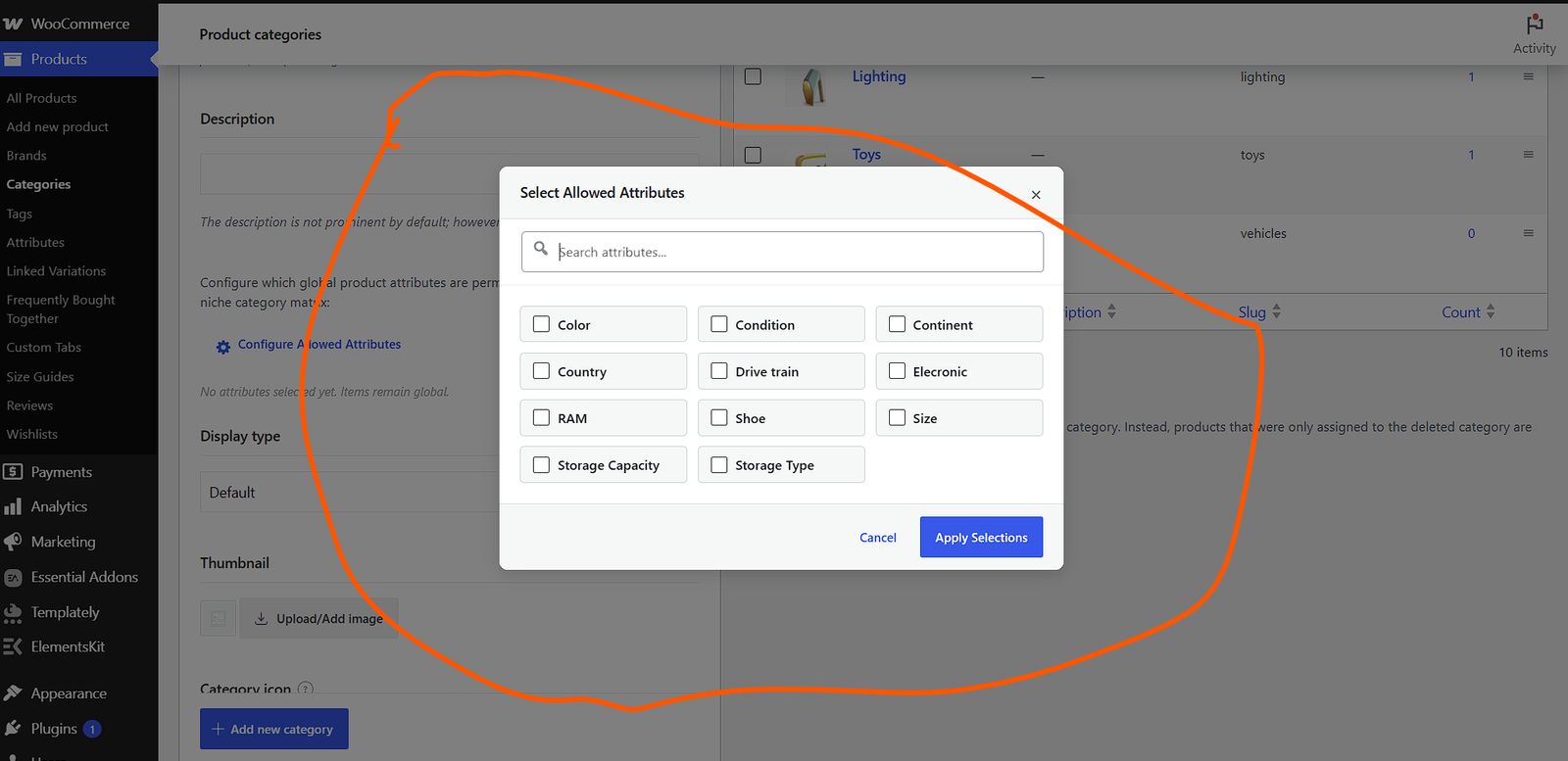
With licensing active, access any product category editing screen in your WordPress admin. The “Allowed Attributes” section presents all WooCommerce global attributes as interactive tiles. Search by name or label, select relevant attributes for the category, and save your configuration. Changes propagate instantly to all vendor dashboards—no cache clearing, no notification emails, no manual vendor updates required.
For marketplaces with extensive category structures, bulk configuration tools and copy-paste functionality between similar categories accelerate the setup process. A marketplace with fifty categories can achieve complete attribute mapping in under an hour.
Automatic Updates and Ongoing Maintenance
The plugin connects to our secure update server to deliver compatibility patches, security fixes, and feature enhancements automatically. When WooCommerce releases a major version, when Dokan introduces dashboard improvements, or when WordPress core updates require adaptation, your marketplace receives the necessary plugin updates through the standard WordPress notification system. Install updates with the same one-click convenience you use for other plugins, confident that each release has been tested against the latest stable versions of all dependencies.
Part of a Complete Marketplace Strategy
Conditional Category for Dokan achieves maximum impact when integrated with a comprehensive marketplace technology stack. The plugin is specifically engineered to complement the Dokan multivendor plugin—the industry-leading solution trusted by over 60,000 active marketplaces worldwide and maintained by the experienced development team at weDevs.
This native partnership ensures:
-
Seamless frontend integration that follows Dokan’s established design patterns and user experience conventions
-
Compatibility with Dokan Pro modules including auctions, bookings, subscriptions, and wholesale functionality
-
Consistent vendor onboarding that requires no retraining when conditional attributes are introduced
-
Reliable support ecosystem where Dokan and conditional attribute expertise coexist within the same professional community
Beyond Dokan, the plugin maintains full compatibility with WordPress core functionality, WooCommerce extensions, and popular third-party tools. Whether your marketplace leverages Yoast SEO for search optimization, WPML for multilingual support, or WooCommerce Subscriptions for recurring billing, Conditional Category for Dokan operates within these established workflows rather than conflicting with them.
The Competitive Advantage of Precision
In a marketplace landscape where platforms compete aggressively for both vendors and customers, small experience improvements compound into decisive competitive advantages. Conditional Category for Dokan delivers these advantages through multiple mechanisms:
Vendor Acquisition and Retention
Professional sellers evaluate platforms based on the efficiency of their listing workflows. When experienced vendors encounter your clean, category-conditional product form after struggling with cluttered alternatives on competing platforms, they recognize immediately that your marketplace respects their time. This positive first impression increases registration completion rates, accelerates time-to-first-listing, and builds the loyalty that reduces vendor churn.
Customer Trust and Conversion
Shoppers who can filter accurately, compare confidently, and trust product specifications convert at higher rates and return more frequently. The structured data enabled by conditional attribute logic powers every stage of the customer journey—from discovery through Google Search to final purchase decision. Marketplaces with superior data quality earn superior customer lifetime value.
Operational Efficiency
Administrators and support staff spend less time resolving vendor confusion, cleaning malformed data, and explaining irrelevant form fields. This efficiency reclaims hours that can be redirected toward growth initiatives: vendor recruitment, marketing campaigns, feature development, and customer experience optimization.
Search Engine Authority
Google’s algorithms increasingly prioritize structured, consistent, comprehensive product data. Marketplaces that enforce attribute quality through conditional logic earn better search visibility, richer snippet displays, and more cost-effective Google Shopping campaigns. This organic advantage reduces customer acquisition costs and builds sustainable traffic growth independent of paid advertising.
Conclusion: Transform Your Marketplace Today
Conditional Category for Dokan represents the intersection of technical excellence and marketplace wisdom. It recognizes that great vendor experiences create great customer experiences, and that great data creates great search visibility. By implementing intelligent, category-conditional attribute filtering, you invest in every dimension of platform success simultaneously.
The marketplace operators who thrive in the coming decade will be those who treat product data governance as a core competency rather than an afterthought. They will build platforms where vendors feel supported, customers feel confident, and search engines recognize quality. Conditional Category for Dokan provides the infrastructure to build that future—starting today.
Ready to join the marketplace operators who refuse to compromise on vendor experience or data quality? Explore our complete feature documentation, review transparent pricing tiers, and activate your license at dokanconditionalattribute.com. Your marketplace transformation begins with a single click.