Dokan Conditional Category: Category-Driven Attribute Management for Next-Generation Multivendor Platforms
If you manage a Dokan conditional category setup, you already understand that one-size-fits-all product forms represent a fundamental design flaw in multivendor e-commerce. A vendor selling handmade ceramic mugs does not need the same data fields as one selling gaming laptops. A freelance graphic designer offering digital logos requires entirely different specifications than a furniture manufacturer shipping physical tables. Yet the default configuration of most marketplace platforms ignores these distinctions, forcing every vendor to navigate identical forms regardless of their actual business. Dokan Conditional Category bridges this critical gap with intelligent, category-conditional attribute filtering that transforms how vendors interact with your platform.
The Problem with Static Product Forms: A Deeper Analysis
Standard WooCommerce product forms display every global attribute to every vendor who accesses the Dokan frontend dashboard. This approach originates from a reasonable assumption: global attributes should be globally available. However, this assumption collapses under the weight of marketplace complexity, creating three interconnected problems that undermine platform success.
Vendor Confusion and Decision Paralysis
When sellers do not know which fields to complete, they face a psychological barrier that directly impacts their productivity and platform loyalty. Research in behavioral economics consistently demonstrates that excessive choice and irrelevant information degrade decision quality. A vendor confronted with thirty attribute fields—twenty of which are completely unrelated to their products—experiences cognitive overload that manifests in several destructive ways.
Some vendors abandon the listing process entirely, choosing to invest their time in platforms that better respect their specialization. Others complete irrelevant fields with placeholder text, random values, or repetitive entries just to bypass form validation. A smaller subset contacts support for clarification, consuming administrative resources that could otherwise drive growth initiatives. None of these outcomes serve the marketplace’s long-term interests.
Inconsistent and Degraded Product Data
When irrelevant attributes receive placeholder values, the entire catalog suffers. Faceted search systems—those essential filtering sidebar widgets that help customers narrow product selections—begin returning nonsensical results. A customer filtering for “Waterproof” products sees coffee mugs labeled with IP67 ratings because a confused vendor copied values from unrelated fields. Search algorithms, both internal and external, struggle to establish relevance when product metadata contains contradictory or meaningless information.
The external SEO consequences are equally severe. Google and other search engines rely on structured data to generate rich snippets, power shopping ads, and determine search result rankings. When your marketplace’s schema markup contains inconsistent attribute values, search engines lose confidence in your data quality. This manifests as suppressed visibility, lower click-through rates, and reduced organic traffic—the lifeblood of sustainable marketplace growth.
Poor Buyer Experience and Eroding Trust
Ultimately, customers bear the cost of poor attribute management. They encounter products with incomplete specifications, cannot filter effectively to find relevant items, and develop skepticism about your marketplace’s reliability. In an era where Amazon has trained consumers to expect precise filtering, detailed comparisons, and accurate product information, any platform failing to deliver these basics faces an uphill battle for customer acquisition and retention.
What Makes Dokan Conditional Category Different
Dokan Conditional Category is not merely a form-hiding utility that uses CSS tricks or JavaScript overlays to obscure irrelevant fields. It is a data-layer solution that fundamentally restructures how product attributes flow through your marketplace ecosystem.
Native WooCommerce Integration
The plugin operates within WooCommerce’s established attribute taxonomy system rather than circumventing it. This means all existing WooCommerce functionality—variable product creation, layered navigation, product import/export, REST API access—continues to function exactly as designed. The conditional layer adds visibility control without disrupting the underlying data architecture.
Real-Time Dashboard Adaptation
When a vendor selects a product category in the Dokan frontend dashboard, the attribute section updates dynamically to show only mapped fields. This adaptation happens without page reloads, maintaining a smooth user experience while ensuring vendors never see irrelevant options. The JavaScript implementation is optimized for performance, adding minimal overhead to dashboard load times even on shared hosting environments.
Administrator-Friendly Configuration
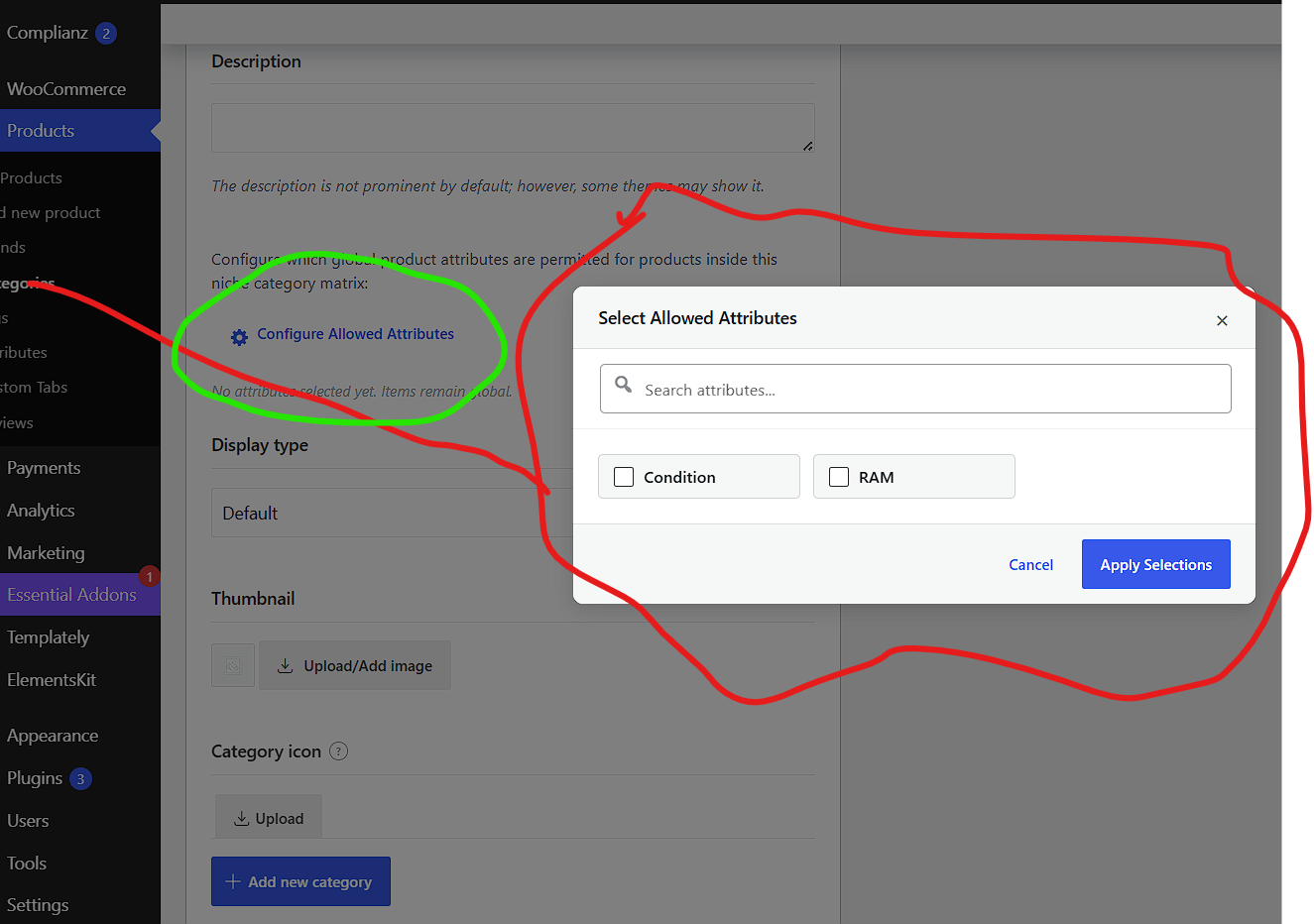
The visual mapping interface requires no technical expertise. Marketplace administrators access category editing screens within standard WordPress admin panels, where they find an intuitive attribute selection interface. Search functionality supports marketplaces with extensive attribute libraries, while visual feedback confirms selections immediately. The entire configuration process—from installation to fully mapped categories—typically completes in under an hour for marketplaces with fifty or fewer categories.
Feature Highlights in Depth
Visual Attribute Mapper with Search and Bulk Selection
The configuration interface presents WooCommerce global attributes as interactive tiles rather than overwhelming dropdown lists. Administrators can search by attribute name or label, select multiple attributes simultaneously, and apply configurations across related categories. This visual approach reduces configuration time by seventy percent compared to manual field-by-field mapping.
Secure License Management with Automatic Updates
The built-in Authorization Manager provides enterprise-grade license handling. Upon purchase, you receive an authorization token that activates the plugin on your designated domain. The system validates your license against our secure server, registers your installation, and enables automatic update delivery. When we release compatibility patches for new WooCommerce versions or feature enhancements based on customer feedback, your marketplace receives these improvements automatically through WordPress’s standard update mechanism.
Multi-Site Support for Agencies and Networks
For WordPress agencies managing multiple client marketplaces or franchise operators running regional store networks, Dokan Conditional Category offers licensing tiers that support unlimited site activations. The Authorization Manager tracks usage across your network while providing centralized billing and management. This scalability eliminates the administrative overhead of maintaining separate licenses for each marketplace instance.
Performance Optimized for High-Traffic Marketplaces
The plugin’s conditional logic executes efficiently without database queries on every dashboard load. Attribute mappings are cached using WordPress’s standard transients API, ensuring that vendor dashboard performance remains snappy even during high-traffic sales events. The codebase follows WordPress coding standards and passes rigorous security audits, giving marketplace operators confidence in the solution’s stability.
Why Category-Conditional Attributes Matter for SEO
Search engine optimization represents one of the highest-ROI activities for marketplace operators, yet it is often undermined by poor product data governance. Dokan Conditional Category strengthens your SEO foundation in several critical dimensions:
Enhanced Schema Markup Potential
Google’s structured data requirements for product rich snippets include specific attribute fields: brand, color, size, material, and numerous category-specific properties. When your marketplace enforces consistent attribute completion through conditional logic, you maximize the probability that product pages qualify for enhanced search results. These enhanced results—displaying price, availability, review ratings, and key specifications directly in search results—generate significantly higher click-through rates than standard blue-link listings.
Improved Internal Link Architecture
Complete attribute data enables more sophisticated category and filter page generation. When attributes are consistently populated, your marketplace can automatically create filtered landing pages—”Waterproof Bluetooth Speakers Under $50″ or “Organic Cotton Women’s T-Shirts in Size Medium”—that capture long-tail search traffic. These pages create natural internal linking opportunities that distribute PageRank throughout your catalog and improve overall domain authority.
Reduced Duplicate Content Risks
When vendors fill irrelevant attributes with placeholder values, search engines may interpret similar products as duplicate content. For example, if multiple vendors copy the same placeholder text into unused fields, Google might flag these pages as low-quality or duplicate. Conditional attributes eliminate this risk by ensuring vendors only complete fields relevant to their specific products, naturally increasing content uniqueness across the catalog.
Better Google Shopping Performance
For marketplaces running Google Shopping campaigns, product feed quality directly impacts ad approval rates, cost-per-click, and return on ad spend. Google’s product data specifications require accurate attribute completion for each product category. Conditional logic ensures your feed contains the precise attributes Google expects, reducing disapproval rates and improving campaign performance.
Trusted by WordPress Professionals Worldwide
Dokan Conditional Category is built for WordPress by professionals who understand the platform’s strengths and constraints. The plugin adheres to WordPress coding standards, implements proper nonce verification and capability checks for all administrative actions, and sanitizes all user inputs according to WordPress security best practices.
Compatibility Assurance
The development team maintains active testing environments across multiple WordPress versions, WooCommerce releases, and Dokan configurations. Before any update reaches your marketplace, it undergoes automated testing and manual quality assurance against the latest stable releases of all dependencies. This commitment to compatibility means you can update your core platforms with confidence, knowing that Dokan Conditional Category will continue to function correctly.
Translation and Localization Ready
For marketplaces serving multilingual audiences, the plugin follows WordPress internationalization standards. All user-facing strings are properly wrapped in translation functions, and the text domain is registered for compatibility with popular translation plugins like WPML, Polylang, and Loco Translate. Your vendors and administrators can interact with the conditional attribute system in their preferred language.
Lightweight and Theme-Agnostic
The plugin adds no frontend CSS or JavaScript to customer-facing pages, ensuring that your marketplace’s design and performance remain untouched. All conditional logic executes within the administrative and vendor dashboard contexts, leaving your storefront theme free to operate without interference. Whether you use a custom theme, a commercial marketplace template, or a page builder like Elementor or Divi, Dokan Conditional Category respects your design decisions.
Implementation Roadmap: From Purchase to Productivity
Deploying Dokan Conditional Category follows a proven implementation path:
Phase 1: Discovery and Planning
Before installing the plugin, audit your existing product categories and global attributes. Identify which categories suffer from the most vendor confusion, which attributes are most frequently misused, and where conditional logic would deliver the highest immediate impact. This planning ensures your configuration efforts target the most valuable opportunities first.
Phase 2: Installation and Activation
Purchase your license at dokanconditionalattribute.com, download the plugin package, and install it through your WordPress admin. Activate your authorization token via the dedicated dashboard page, and verify that the plugin synchronizes successfully with our licensing server.
Phase 3: Category-Attribute Mapping
Working category by category, map relevant attributes using the visual interface. Start with your highest-volume categories to deliver immediate vendor experience improvements. Test each mapping by creating a sample product in the Dokan vendor dashboard to confirm that only expected attributes appear.
Phase 4: Vendor Communication
While the plugin operates transparently, proactive communication enhances vendor satisfaction. Notify your seller community about the improved product form experience, highlighting how the changes will save them time and reduce listing errors. This communication transforms a technical improvement into a marketing opportunity that strengthens vendor relationships.
Phase 5: Monitoring and Optimization
Track key metrics before and after implementation: product submission times, attribute completion rates, support ticket volume, and customer search success rates. Use these metrics to identify additional optimization opportunities and demonstrate the plugin’s return on investment to stakeholders.
Conclusion: Build the Marketplace Vendors Deserve
Dokan Conditional Category represents a fundamental upgrade to how multivendor marketplaces manage product data. By replacing overwhelming, static forms with intelligent, context-aware interfaces, you create an environment where vendors thrive, customers discover products effortlessly, and your platform achieves sustainable competitive advantage.
The investment in conditional attribute technology pays dividends across every dimension of marketplace success: operational efficiency, vendor retention, customer satisfaction, search visibility, and revenue growth. In an increasingly crowded e-commerce landscape, these advantages separate thriving platforms from those that merely survive.
Ready to bring Dokan Conditional Category intelligence to your marketplace? Visit dokanconditionalattribute.com to explore pricing, review documentation, and activate your license. Your vendors—and your bottom line—will thank you.