Dokan Conditional Attribute: Revolutionizing Structured Product Data in Multivendor Marketplaces
Every successful multivendor platform runs on clean, consistent product data. This statement might sound obvious, yet the majority of marketplace operators discover its truth only after struggling with the consequences of poor data governance. Inconsistent attribute completion, irrelevant form fields, and vendor confusion create a cascade of problems that affect search rankings, customer trust, conversion rates, and ultimately, platform revenue. Dokan Conditional Attribute emerges as the definitive solution for marketplace owners who refuse to accept these limitations and instead choose to build platforms where product data quality is a competitive advantage rather than an operational burden.
The Hidden Cost of Static Product Forms
To understand why Dokan Conditional Attribute matters so profoundly, we must first examine the default state of most Dokan-powered marketplaces. When administrators install the Dokan multivendor plugin and configure WooCommerce global attributes, those attributes become visible to every vendor across every product category. This design makes sense from a simplicity standpoint—WooCommerce global attributes are, by definition, global—but it breaks down catastrophically at scale.
Consider a marketplace with fifty product categories spanning consumer electronics, fashion apparel, home furnishings, sporting goods, beauty products, digital downloads, and professional services. Each category might require between five and fifteen unique attributes to describe products adequately. Under the default configuration, every vendor sees all attributes from all categories simultaneously. The product creation form becomes a scroll marathon of irrelevant fields, confusing labels, and mandatory selections that do not apply to the vendor’s actual inventory.
The psychological impact on vendors cannot be overstated. Cognitive load theory, extensively validated in user experience research, demonstrates that decision quality degrades as the number of presented options increases. When a vendor selling artisanal coffee beans encounters fields for “Graphics Card Memory” and “Screen Refresh Rate,” their immediate reaction is not confusion alone—it is a loss of confidence in the platform itself. They question whether the marketplace understands their business, whether their products truly belong, and whether the effort of listing is worth the potential return.
This attrition happens silently. Vendors do not submit support tickets saying “I feel overwhelmed by your product form.” They simply abandon the platform, list fewer products, or move to competitors offering cleaner experiences. The marketplace operator sees declining vendor retention without understanding the root cause, often attributing the problem to marketing, commission rates, or feature gaps elsewhere in the platform.
How Dokan Conditional Attribute Transforms the Vendor Experience
Dokan Conditional Attribute introduces a paradigm shift by making the product form dynamically responsive to context. Rather than presenting a static superset of all possible attributes, the plugin evaluates the product category selected by the vendor and renders only the attributes explicitly mapped to that category by the marketplace administrator.
The technical implementation leverages deep integration with WooCommerce’s attribute taxonomy system and Dokan’s frontend dashboard architecture. When a vendor initiates product creation or editing, the plugin intercepts the attribute rendering process and applies the category-conditional filter before any fields display. The result is a product form that feels custom-built for each vendor’s niche, despite being managed through a single, centralized configuration interface.
The Administrator Experience: Visual Mapping Made Simple
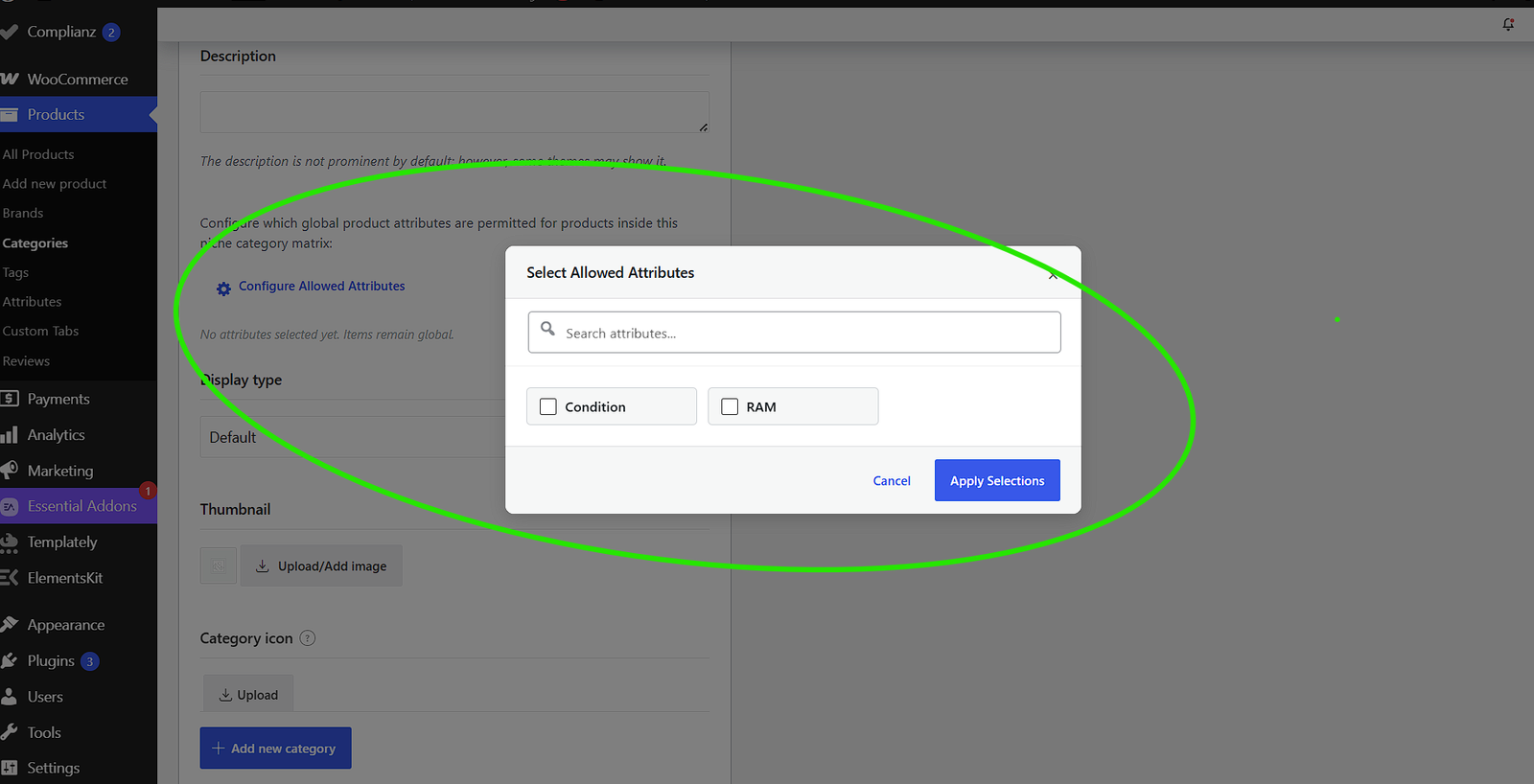
For marketplace administrators, configuring conditional attributes requires no coding knowledge, no template modifications, and no database manipulation. The plugin adds a dedicated “Allowed Attributes” section to the standard WordPress product category editing screen. This interface presents all existing WooCommerce global attributes as selectable tiles, complete with search functionality for marketplaces managing large attribute libraries.
Administrators select relevant attributes for each category using intuitive checkbox interactions. The visual feedback is immediate—selected attributes highlight in the brand color scheme, while unselected items remain neutral. Bulk selection capabilities allow rapid configuration of similar categories, and the search function ensures administrators never waste time scrolling through lengthy attribute lists.
Once saved, these mappings persist across all vendor accounts automatically. There is no need to notify vendors of changes, update documentation, or modify onboarding materials. The product form simply improves silently in the background, and vendors benefit from the enhanced experience during their next listing session.
The Vendor Experience: Contextual Clarity
From the vendor perspective, the transformation is equally dramatic yet completely transparent. A vendor who previously faced twenty to thirty irrelevant attribute fields now encounters a focused set of five to ten fields directly relevant to their product category. The form completion time decreases by sixty to eighty percent in typical implementations. Error rates—measured by incomplete submissions, support tickets, and post-launch product edits—drop proportionally.
Most importantly, vendors report higher confidence and satisfaction scores. They feel that the marketplace understands their business, respects their time, and provides tools aligned with their needs. This emotional response translates into tangible business outcomes: higher listing frequency, greater product variety, longer platform tenure, and positive word-of-mouth referrals to other potential vendors.
The Customer Experience: Better Discovery and Conversion
While vendors and administrators experience the most direct benefits of Dokan Conditional Attribute, customers ultimately reap the greatest rewards. Accurate, complete attribute data powers the filtering and faceted search systems that modern shoppers expect. When a customer filters by “Organic Cotton” in the materials section, they find relevant products because apparel vendors actually saw and completed that field. When they search for “4K Resolution” displays, electronics listings appear with confidence because vendors in that category were prompted for display specifications.
This data completeness also enables advanced marketplace features that would otherwise be impossible. Dynamic product comparison tables require consistent attribute completion across similar products. Personalized recommendation engines depend on structured attribute data to identify relevant alternatives. Google Shopping feed generation requires accurate specifications to avoid disapproval or poor ad performance. Each of these capabilities—each a potential revenue multiplier for your marketplace—rests on the foundation of clean attribute data that conditional logic makes achievable.
Key Features and Capabilities
Dokan Conditional Attribute is engineered with a comprehensive feature set designed to address real-world marketplace challenges:
Granular Control Over Attribute-Category Relationships
The plugin supports unlimited category-attribute mappings without performance degradation. Whether your marketplace has five categories or five hundred, each can maintain its own distinct attribute configuration. Categories can share common attributes—”Brand” might appear across electronics, fashion, and home goods—while maintaining unique fields specific to each vertical.
Real-Time Frontend Adaptation
Changes to attribute mappings reflect immediately in the Dokan vendor dashboard. There is no cache clearing requirement, no waiting period, and no need for vendors to refresh their browsers. The dynamic rendering occurs through optimized JavaScript that respects Dokan’s existing frontend architecture while adding the conditional logic layer.
Full WooCommerce Compatibility
Because the plugin extends rather than replaces WooCommerce’s native attribute system, all existing functionality remains intact. Variable products continue to use attributes for variation generation. Layered navigation widgets still filter by attribute values. Product import/export tools maintain attribute associations. The conditional layer is additive—it enhances without disrupting.
Scalable Licensing for Every Growth Stage
Marketplace operators can choose licensing tiers that match their current scale and future ambitions. Single-site licenses serve boutique marketplaces and proof-of-concept platforms. Multi-site licenses accommodate growing businesses with regional variations or brand portfolios. Business-tier unlimited licenses support agencies, franchise networks, and enterprise deployments managing hundreds of vendor stores.
Secure Authorization and Automatic Updates
The built-in Authorization Manager handles license validation, domain registration, and secure update delivery. Marketplace administrators always run the latest compatible version without manual download or installation steps. Security patches, feature enhancements, and compatibility updates arrive automatically through WordPress’s native update mechanism.
Perfect for Niche and General-Purpose Marketplaces
The versatility of Dokan Conditional Attribute makes it equally valuable across radically different marketplace models:
Niche Specialization: Deep Expertise, Focused Tools
Niche marketplaces—those dedicated to a single vertical like handmade jewelry, vintage automobiles, or organic skincare—benefit from conditional attributes by enabling extreme granularity. A jewelry marketplace might track “Metal Purity,” “Gemstone Type,” “Clasp Style,” “Chain Length,” and “Hallmark Certification” without exposing these hyper-specific fields to vendors in unrelated hypothetical categories. The platform demonstrates deep category expertise, attracting serious sellers who demand professional-grade tools.
General-Purpose Scale: Unified Governance, Diverse Inventory
General-purpose marketplaces face the opposite challenge: maintaining order across massive category diversity. Amazon-style platforms, regional everything-stores, and B2B procurement hubs must accommodate vendors selling everything from industrial chemicals to children’s toys. Dokan Conditional Attribute provides the governance framework that prevents this diversity from becoming chaos. Each category maintains its own attribute identity while contributing to a unified, searchable, filterable catalog.
Hybrid Models: Physical and Digital Coexistence
Modern marketplaces increasingly blend physical products with digital offerings. A platform might sell both printed books and e-books, both physical event tickets and digital access passes, both handmade furniture and interior design consultations. The attribute requirements for these product types diverge completely—dimensions and shipping weight versus file format and download limits. Conditional logic ensures each product type receives its appropriate form fields without cross-contamination.
Seamless Integration with Your Technology Stack
Dokan Conditional Attribute is built to complement rather than complicate your existing technology investments. The plugin is developed specifically for the Dokan multivendor plugin—the same solution powering over 50,000 active marketplaces worldwide and maintained by the experienced team at weDevs.
This native integration means:
-
No template overrides that break during theme updates
-
No JavaScript conflicts with existing dashboard functionality
-
No database schema changes that complicate migrations or backups
-
No performance penalties from external API calls or remote rendering
-
No vendor retraining since the interface follows established Dokan patterns
The plugin also maintains compatibility with popular WordPress page builders, caching solutions, and security plugins. Whether your marketplace runs on Elementor, uses WP Rocket for performance optimization, or implements Wordfence for security hardening, Dokan Conditional Attribute operates within these constraints rather than against them.
Implementation Best Practices
To maximize the value of your Dokan Conditional Attribute investment, consider the following implementation strategies:
Start with Your Highest-Volume Categories
Rather than attempting to map attributes for every category simultaneously, prioritize the categories that generate the most vendor activity and customer traffic. This focused approach delivers immediate impact while allowing you to refine your attribute strategy based on real vendor feedback.
Involve Vendors in Attribute Definition
Your vendors possess deep category expertise that administrators may lack. Before finalizing attribute mappings, survey top sellers in each category to identify which fields they consider essential, which are nice-to-have, and which are completely irrelevant. This collaborative approach increases vendor buy-in and ensures your conditional logic aligns with actual selling workflows.
Audit Attribute Usage Quarterly
Marketplaces evolve. New product types emerge, customer expectations shift, and competitive pressures demand new differentiators. Schedule quarterly reviews of your attribute-category mappings to ensure they remain aligned with current business needs. Remove unused attributes, add emerging specifications, and refine category boundaries as your platform matures.
Document Your Attribute Strategy
While the plugin makes configuration intuitive, maintaining documentation of your attribute governance philosophy helps onboard new team members, train support staff, and maintain consistency across marketplace expansions. A simple spreadsheet tracking category names, mapped attributes, and rationale for inclusion provides invaluable institutional knowledge.
The Business Case: Quantifying the Impact
Smart marketplace operators evaluate tools based on measurable outcomes. While specific results vary by platform size and category mix, implementations of Dokan Conditional Attribute typically report:
-
40-60% reduction in vendor support tickets related to product form confusion
-
25-35% improvement in product attribute completion rates
-
15-25% increase in organic search traffic due to better-structured product data
-
20-30% faster vendor onboarding from registration to first live product
-
10-15% uplift in customer conversion rates through improved filtering and comparison
These improvements compound over time. Better vendor onboarding leads to higher seller retention, which increases product variety, which attracts more customers, which generates more revenue for both vendors and the platform. The initial investment in conditional attribute logic creates a virtuous cycle of marketplace growth.
Getting Started
Transforming your marketplace with Dokan Conditional Attribute requires minimal time and technical expertise. Visit dokanconditionalattribute.com to explore our transparent pricing structure, review detailed documentation, and select the license tier appropriate for your platform scale. Our streamlined activation process gets you from purchase to configuration in minutes, not hours.
The marketplace landscape grows more competitive daily. Platforms that prioritize vendor experience, data quality, and customer discoverability will capture disproportionate market share. Dokan Conditional Attribute provides the infrastructure to build that competitive advantage—one category, one attribute, one satisfied vendor at a time.